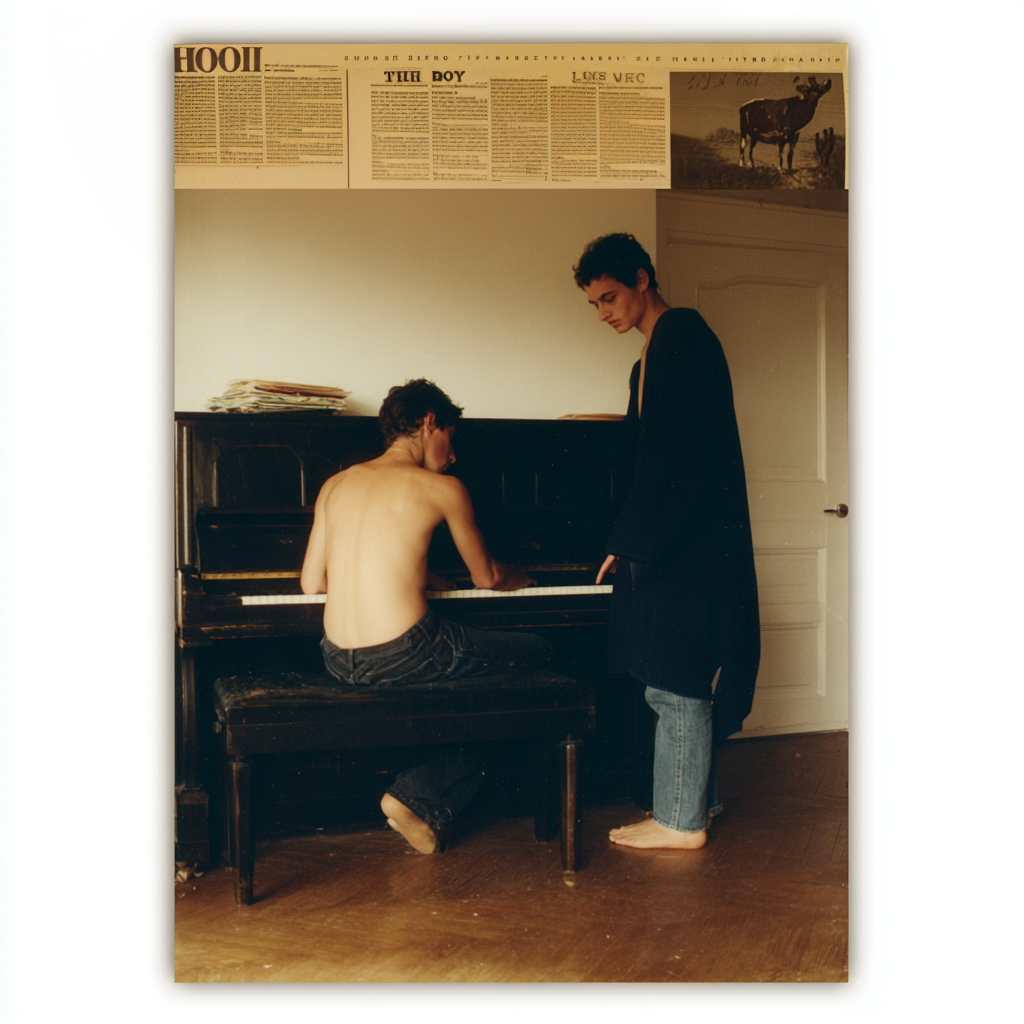
THE LOST BOY
This is the story of a boy.
It was a melancholy day. The sky was cloudier than usual, and the air felt heavy. Yet to one boy, it was a very special day. Full of anticipation, he had risen early and was sitting alone in his room.
After sitting there for a long while, he looked down at his feet and realized how strangely shaped they were. His second toe seemed far too long compared with the first, while his smallest toe seemed much too short beside the fourth. He studied them for some time, lost in thought, before turning his attention to the sounds coming from his parents’ bedroom across the hall.
From the other room came his mother’s voice, strained as though she were in pain, and his father’s voice, sounding terribly angry. The boy sat still and listened. He remembered another time when he had heard the same sounds and, frightened, had burst into their room. His mother and father had been naked. His father had immediately seized him, thrown him out, and later punished him severely.
Remembering this, the boy shook his head and decided to have breakfast. He went downstairs, took cereal from a kitchen cupboard and milk from the refrigerator, poured them into a bowl, and sat quietly at the table to eat.
Just as he placed the empty bowl in the sink, his mother came into the kitchen. Whenever those sounds had come from the bedroom, she would afterward cover her face with her hands, as though trying to hide her flushed cheeks. The boy still wondered about it, but he no longer asked.
His mother took a glass from the cupboard and poured herself some juice. Then she pressed the cool glass against her burning face and stood there for a while. When she finally noticed the boy, she gave a start.
“You’re up early.”
As she spoke, she pulled down her sleeve, concealing marks the same shade of purple as those that had once appeared on the boy’s body after his father punished him.
The boy watched her in silence.
“Yes,” he said, and went into the bathroom.
He did not particularly enjoy washing, but he liked turning on the water and sitting beside it. He liked watching the droplets strike the floor. That was why rainy days were his favorite.
After sitting in the bathroom for a long time, he remembered that it was his grandmother’s birthday and decided he ought to hurry. He undressed and stepped into the tub. He washed himself with soap, and as soon as foam covered his skin, he rinsed it away. When he was finished, he stood before the mirror and carefully dried every part of his body with a towel. Then he went upstairs and put on the sweater his grandmother had bought him.
His grandmother was his favorite person in the world.
Other people might have found her boring, but to the boy she had always been both a good teacher and a good friend. She listened to him more carefully than anyone else. She never judged him, and she never questioned him. They often passed the time playing board games. They said nothing as they played, but in the quiet between them, each found a certain contentment.
To understand what kind of person his grandmother was, one might think of the day they went to an ice cream shop together.
The boy could not decide which flavor he wanted and stood at the counter for a very long time. His grandmother waited without a word. When at last he made his choice, she asked the clerk for the same flavor and turned to him with a small smile.
That was the kind of person she was.
Once he was ready, the boy sat in the living room and switched on the television. He flipped through the channels until his favorite cartoon began, then set the remote beside him and gave the screen his full attention. The story grew more and more exciting, and he became so absorbed that he did not hear his father coming downstairs.
As usual, his father appeared in his underwear. He sat beside the boy, picked up the remote, and changed the channel. The boy wanted to watch his cartoon to the end, but, as though long accustomed to such things, he simply left the living room and went upstairs.
Below, his father began laughing loudly at something he found very amusing. The boy did not want to hear it, so he shut his bedroom door. But his mother’s voice, humming cheerfully as she dressed, filled his room. He opened the door again and went to ask when they would be leaving for his grandmother’s house.
His mother told him there was still plenty of time. Instead of staying home, she said, he should go outside and buy his grandmother a present. Then she pressed some money into his hand.
The boy put the money in his pocket, went downstairs, and stepped outside. The sky was still gray, as though rain were falling somewhere nearby, and this made him feel unusually refreshed. Watching the raindrops clinging to the grass, he continued along the road.
He walked for a long time. When at last he raised his head, he realized he had reached a place he had never seen before. He looked around, trying to work out where he was, but could not be certain. Deciding he had wandered too far, he turned back toward home.
On the way, he noticed a shop he had not seen before. Remembering that he needed a present for his grandmother, he went inside and began examining the merchandise. Nothing pleased him. He wanted to give his grandmother something very special, and not one object in the shop appeared special enough.
“What can I help you find, sir?” the clerk asked, as though the boy’s problem might easily be solved.
But the boy did not believe another person could choose the right gift for his grandmother, so he said nothing. In the end, he left the shop empty-handed.
After another long walk, he arrived home. The moment he opened the door, his father shouted at him. Where on earth had he been? They were already terribly late. He was to get into the car at once.
The boy went back outside, opened the car door, and climbed in. His parents came running toward the car, screaming at each other, their faces twisted with anger. His mother opened her door, crushed out the cigarette she had been holding, and sat down. His father started the engine the instant he climbed in and drove away.
His mother demanded to know why he had taken so long.
“I was buying Grandmother’s present,” the boy said.
In a voice less angry than before, she asked what he had bought.
“Nothing.”
She turned toward him and began shouting again. His father looked at him as well.
“I can’t understand how a child like that came from me.”
The boy, familiar with such scenes, said nothing and gazed out the window. Only when they were nearly at his grandmother’s house did his father’s anger begin to subside.
After they arrived, the boy’s mother warned him not to say strange things to anyone. The boy nodded as though he understood and immediately got out of the car.
At the front door, he rang the bell, but no one answered. Only after the third ring did the door open. The person standing there was not his grandmother but his aunt, which the boy found very strange. He could not understand why someone else was answering the door to his grandmother’s house.
He asked his mother why Grandmother had not opened it herself.
His mother explained that they were throwing her a surprise birthday party. Everyone had come early to prepare.
Still, the boy did not understand. Would his grandmother truly like other people opening her front door as though the house belonged to them?
The house was crowded. Most of the guests were relatives, though many were strangers to him. Uncomfortable among so many people, the boy went to the room where he and his grandmother usually spent their time. But it too was full of cousins. He left again and went to sit alone on a bench in the garden.
One of his cousins noticed him and came over. The cousin complained without pause—about how boring the party was, about why Grandmother had not arrived yet, and about why old people were always so slow.
The boy listened without answering. Irritated by his silence, the cousin complained about Grandmother even more fiercely. The boy could not understand it. He wondered whether, among all these people, even one had come because they truly wanted to see her.
No longer wishing to listen, he escaped the flood of complaints and went back inside.
The first thing he saw was his father, sitting on the sofa as always. He held a cigarette in one hand and a glass of wine in the other. His cheeks were stained red, and his unfocused eyes seemed to have lost their way.
When he saw the boy, he crooked a finger and beckoned him closer.
“Are you upset because Grandmother still isn’t here?” he said when the boy approached. “She isn’t coming because you’re here.”
All at once, the boy became convinced that he should not be there. Just as his father had said, this was not a place where he belonged.
He threw open the front door and ran. A bitter wind cut across his body, but he did not stop. He ran faster and faster. By the time his breath began to fail, he found himself standing before a bus station.
He wanted to go somewhere no one knew him. He decided to take a bus as far away as he could. But he did not know how to buy a ticket, so he stood in front of the ticket window for a long time.
A man who found his behavior strange approached and asked whether something was wrong.
The boy asked the stranger to buy him a bus ticket.
“Where are you going?” the man asked.
“Anywhere.”
The boy handed him the money that had been meant for his grandmother’s present. The stranger looked at him uncertainly but asked no more questions. He bought the ticket and gave it to him.
The boy walked toward the bus platform. Watching the small figure disappear into the distance, the stranger regretted having helped him.
The boy sat in the last row of the bus. There were not many passengers, but he was pleased to have the back seats entirely to himself. The bus departed, and as time passed, the sky outside grew darker. Watching it, the boy’s eyelids also began to close.
When he opened his eyes again, darkness lay everywhere. He realized that no one else remained on the bus.
He opened a window and climbed out. Outside stood buildings unlike any he had ever seen. He understood that he was somewhere entirely new, and the realization filled him with boundless relief. He was deeply pleased that not a single person there knew him.
He wandered the streets for a long time. His legs grew tired, but he did not care. Then he heard a strange sound.
At first, he could not tell where it came from. As it grew clearer, he realized it was rising from a sewer. Curious, the boy decided to go inside.
Darkness enclosed him on every side. He could not see what lay ahead. There was nothing he could do but follow the sound deeper into the tunnel.
As it grew clearer, he recognized it as a human voice. Soon he knew he was close. He hid behind a wall and peered around it.
A small light glowed in the chamber beyond. In its center stood a man with a white beard. Around him, countless bags filled with white powder were piled high. The boy stared at the white-bearded man among the bags for a long while before realizing that they were not alone.
Other people were gathered there. Their eyes shone with delight, and the smiles on their lips told the boy how happy they were.
Sensing someone nearby, the white-bearded man looked around and spotted the boy behind the wall. He stared at him for a moment, then burst into laughter. Enchanted by the harmless warmth of that laughter, the boy began laughing too.
The man walked toward him. Even as he came closer, the boy felt no fear. He was only curious. He wanted to know what sort of person this was.
“Little prince,” the man said, “what brings you to such a shabby place?”
“I followed the sound.”
The man looked down at the boy’s hand, then put an arm around his shoulders and led him into the chamber.
“This place is halfway between earth and heaven,” he said.
The boy did not understand. He asked why.
“Because the white powder beside you sends people up to heaven and then brings them back down to earth.”
The boy looked at the people around him. White powder clung beneath all their noses, and each appeared as happy as though dreaming a beautiful dream. He watched in fascination, wondering whether they truly were in heaven.
Before long, however, some of those who had seemed happy began to weep. In others, bright eyes rapidly emptied.
“Mister, why don’t they look happy anymore?” the boy asked.
The man explained that every magic powder had a time when its spell ended. When people returned to reality, they became unhappy again.
No sooner had he finished speaking than he drove all the changed people out of the sewer.
He immediately began cleaning the place where they had been.
“What is heaven like?” the boy asked, watching him.
The man said he did not know. He knew what a moment of heaven felt like, but he did not know what heaven truly was.
The boy did not fully understand. Still, he decided it was time to leave the sewer. When he turned to go, the man stepped in his way and asked him to stay a little longer.
The boy had nowhere in particular to go, and he was curious about how the white powder sent people to heaven. He nodded.
After cleaning, the man began counting the bags of powder. Suddenly, an enraged woman’s voice rang through the tunnel.
“You’re trash,” she shouted at him. “Nothing but trash.”
The man shouted back. The woman began hurling the stacked bags across the chamber. Then the man did exactly what the boy’s father had done to his mother.
The boy responded as he always had in such moments.
He ran.
He burst out of the sewer and ran faster and faster.
After running for a long time, he saw the woman from the sewer and stopped. Because he had nowhere else to go, he began following her at a distance.
She would stand in one place for a long while, then move on. Whenever a car approached, she leaned toward the window and spoke to the driver before continuing down the street.
At last she realized someone was following her and turned around.
“What do you want, little one?” she asked when their eyes met. “Why do you keep following me?”
“I have nowhere to go.”
The woman studied him for some time, then waved for him to come closer. To another woman standing nearby, she said, “I’m going home early tonight.”
She waited until the boy reached her side.
“Where are your parents?”
The boy said nothing. She did not ask again.
They walked together to her home. She stopped before an old brown building and told him to follow. They took the elevator to the third floor.
“This is my place.”
She took a key from her bag and opened one of the many doors lining the corridor.
The apartment smelled of cheap perfume, yet beneath that sharp scent was something soft and comforting. The boy felt safe there.
“You’re hungry, aren’t you?” she asked. “I made a sandwich this morning. Would you like it?”
The boy had eaten nothing since breakfast, so he nodded.
She went into the kitchen, brought him the sandwich and a glass of milk, and said, “Don’t just stand there. Sit on the sofa and eat.”
He sat down and ate quietly while the woman watched him.
When he had finished, he asked, “Where should I put the plate?”
“Leave it. I’ll take care of it later.”
She sat beside him, turned on the television, and found a cartoon she thought he might like. Then she went into the bedroom to change.
When she returned, the tight clothes she had been wearing were gone. She wore a loose T-shirt and long cotton trousers. She did not press him to speak. Instead, she took chocolate cookies from a cupboard, placed them beside him, and watched television with him.
The boy picked up a cookie and glanced at her. She gave him a small smile to show that it was all right.
The woman could not concentrate on the television. She kept stealing glances at the boy. It was the anniversary of the day she had given up her own son for adoption, and the boy reminded her of him. She wondered whether his arrival that night might be fate.
In the woman’s furtive glances, the boy recognized the look in his grandmother’s eyes. He set down the cookie and gripped the woman’s hand tightly. She looked at him.
Before long, his eyes grew heavy as he watched the cartoon, and he slowly fell asleep.
When he awoke, a blanket covered his body and a delicious smell drifted from the kitchen. He sat up and saw the woman standing there.
“Did you sleep well?” she asked with a bright smile.
“Yes.”
Humming a song, she told him breakfast was nearly ready and asked him to sit at the table. The boy folded the blanket before taking his seat.
The table was covered with fruit. Bacon and bread lay to one side. The woman ladled soup from a pot, brought it to him, then sat opposite with a bowl of her own.
“Eat before it gets cold.”
It had been a long time since the boy had eaten soup like this. He devoured it without looking up. Soon the bottom of the bowl appeared, and the woman filled it again.
Only after finishing the second bowl did he raise his head. The woman looked at him and burst out laughing.
“Who eats soup with it smeared all over his face?”
She pointed to his nose. The boy wiped away the soup and began laughing too. Their laughter filled the apartment.
When at last they had quieted, she told him to go and brush his teeth. In the bathroom, he used the new toothbrush she had laid out for him while she slowly cleaned the kitchen.
When he returned, he watched her standing there and thought of his grandmother. He decided he must go home and wish her a happy birthday.
“I think I have to go now,” he said. “It’s my grandmother’s birthday.”
The woman wanted to ask him to stay a little longer, but she knew she could not.
“Come and visit again,” she said with a smile, “whenever you want some soup.”
The boy went into the kitchen, wrapped his arms around her tightly, then turned away, opened the door, and left.
He took the elevator to the ground floor and stepped outside. Remembering where the bus station had been, he began walking in that direction.
Only when he arrived did he realize he had no money for a ticket. He sat nearby, trying to think of a way onto the bus, but no answer came.
After he had been sitting there for some time, a man approached.
“Why are you sitting here?”
“I have to take the bus, but I don’t have money for a ticket.”
“Then help me with something for a moment, and I’ll buy one for you.”
The boy agreed and followed him.
The man led him to a shipping container near the station. Inside, the boy saw a large bed. The man told him to take off his clothes and rest for a while. He would go to the station and buy the ticket.
The boy agreed. He removed everything except his underwear and placed his clothes to one side.
The man said the underwear might soil the bed and told him to remove that as well. The boy thought it would be wrong to dirty another person’s bed, so he obeyed.
The man told him to get beneath the covers and rest, then left him alone.
The boy lay in the bed thinking of how much he wanted to see his grandmother.
A long time passed, but the man did not return. The boy grew anxious and decided to dress and leave. As he rose from the bed, a different man entered the container.
The newcomer smiled as if pleased by what he saw.
“You need a bus ticket, don’t you?”
“Yes. I have to go home.”
The man said he would get one immediately if the boy helped him first. Before he had even finished speaking, he began removing his clothes.
The boy sensed that something was wrong.
“What do I have to help you with?”
The man said all he had to do was lie on the bed beside him. He seized the boy, forced him down, and began running his hands over the boy’s body.
The boy knew he had to escape. He pushed with all his strength, but he was still only a child and could not overcome the man.
Realizing he could not get away, he was consumed by terror.
Then he understood that he could not run this time. He had to fight with everything he had.
He grabbed a flowerpot beside the bed and struck the man’s head as hard as he could. The man collapsed, unconscious.
The boy snatched up his clothes and ran for his life. He found a nearby restroom, washed his entire body with water, dressed again, and began running once more, desperate to put as much distance as possible between himself and the bus station.
At last his legs gave way, and he crumpled to the ground.
Across the road stood a bakery.
The baker saw the boy collapse and ran outside. He helped him up and brought him into the shop. The baker’s wife gave him a glass of water and brushed the dirt from his knees.
The baker came closer.
“Child, what happened to you?”
“I was trying to go home,” the boy said.
Then he began to cry.
The baker asked nothing more. He simply put his arms around him.
The boy leaned against the man and wept for a long time. When he had finally grown calmer, the baker asked once more, “What happened, child?”
“I just want to go home.”
The baker did not question him again. Instead, he walked with him to the bus station.
The closer they came, the more violently the boy’s hand trembled. The baker held it tight, and the boy gripped his hand in return as they walked slowly forward.
At the station, the baker bought him a ticket. He also gave him some bread from the bakery and a little money.
“Don’t worry, child,” he said. “Everything will be all right. Don’t be afraid. Go home now.”
He accompanied the boy all the way to the bus.
The baker stood there for a long while. When the bus pulled away, he waved to the boy, then turned and walked back.
The boy watched the baker’s receding figure until it vanished from sight. He tore off small pieces of the bread and put them in his mouth.
The bread had grown a little cold, but to the boy it was warmer and more delicious than anything he had ever tasted.
As he gazed out the window, he remembered everything that had happened over the past day and thought about it for a long time.
By the time the sky began to darken, the bus reached the neighborhood near his grandmother’s house. The boy got off and slowly began walking back.
Along the way, he noticed a shop. He went inside and bought a present for his grandmother.




THE LOST BOY
This is the story of a boy.
It was a melancholy day. The sky was cloudier than usual, and the air felt heavy. Yet to one boy, it was a very special day. Full of anticipation, he had risen early and was sitting alone in his room.
After sitting there for a long while, he looked down at his feet and realized how strangely shaped they were. His second toe seemed far too long compared with the first, while his smallest toe seemed much too short beside the fourth. He studied them for some time, lost in thought, before turning his attention to the sounds coming from his parents’ bedroom across the hall.
From the other room came his mother’s voice, strained as though she were in pain, and his father’s voice, sounding terribly angry. The boy sat still and listened. He remembered another time when he had heard the same sounds and, frightened, had burst into their room. His mother and father had been naked. His father had immediately seized him, thrown him out, and later punished him severely.
Remembering this, the boy shook his head and decided to have breakfast. He went downstairs, took cereal from a kitchen cupboard and milk from the refrigerator, poured them into a bowl, and sat quietly at the table to eat.
Just as he placed the empty bowl in the sink, his mother came into the kitchen. Whenever those sounds had come from the bedroom, she would afterward cover her face with her hands, as though trying to hide her flushed cheeks. The boy still wondered about it, but he no longer asked.
His mother took a glass from the cupboard and poured herself some juice. Then she pressed the cool glass against her burning face and stood there for a while. When she finally noticed the boy, she gave a start.
“You’re up early.”
As she spoke, she pulled down her sleeve, concealing marks the same shade of purple as those that had once appeared on the boy’s body after his father punished him.
The boy watched her in silence.
“Yes,” he said, and went into the bathroom.
He did not particularly enjoy washing, but he liked turning on the water and sitting beside it. He liked watching the droplets strike the floor. That was why rainy days were his favorite.
After sitting in the bathroom for a long time, he remembered that it was his grandmother’s birthday and decided he ought to hurry. He undressed and stepped into the tub. He washed himself with soap, and as soon as foam covered his skin, he rinsed it away. When he was finished, he stood before the mirror and carefully dried every part of his body with a towel. Then he went upstairs and put on the sweater his grandmother had bought him.
His grandmother was his favorite person in the world.
Other people might have found her boring, but to the boy she had always been both a good teacher and a good friend. She listened to him more carefully than anyone else. She never judged him, and she never questioned him. They often passed the time playing board games. They said nothing as they played, but in the quiet between them, each found a certain contentment.
To understand what kind of person his grandmother was, one might think of the day they went to an ice cream shop together.
The boy could not decide which flavor he wanted and stood at the counter for a very long time. His grandmother waited without a word. When at last he made his choice, she asked the clerk for the same flavor and turned to him with a small smile.
That was the kind of person she was.
Once he was ready, the boy sat in the living room and switched on the television. He flipped through the channels until his favorite cartoon began, then set the remote beside him and gave the screen his full attention. The story grew more and more exciting, and he became so absorbed that he did not hear his father coming downstairs.
As usual, his father appeared in his underwear. He sat beside the boy, picked up the remote, and changed the channel. The boy wanted to watch his cartoon to the end, but, as though long accustomed to such things, he simply left the living room and went upstairs.
Below, his father began laughing loudly at something he found very amusing. The boy did not want to hear it, so he shut his bedroom door. But his mother’s voice, humming cheerfully as she dressed, filled his room. He opened the door again and went to ask when they would be leaving for his grandmother’s house.
His mother told him there was still plenty of time. Instead of staying home, she said, he should go outside and buy his grandmother a present. Then she pressed some money into his hand.
The boy put the money in his pocket, went downstairs, and stepped outside. The sky was still gray, as though rain were falling somewhere nearby, and this made him feel unusually refreshed. Watching the raindrops clinging to the grass, he continued along the road.
He walked for a long time. When at last he raised his head, he realized he had reached a place he had never seen before. He looked around, trying to work out where he was, but could not be certain. Deciding he had wandered too far, he turned back toward home.
On the way, he noticed a shop he had not seen before. Remembering that he needed a present for his grandmother, he went inside and began examining the merchandise. Nothing pleased him. He wanted to give his grandmother something very special, and not one object in the shop appeared special enough.
“What can I help you find, sir?” the clerk asked, as though the boy’s problem might easily be solved.
But the boy did not believe another person could choose the right gift for his grandmother, so he said nothing. In the end, he left the shop empty-handed.
After another long walk, he arrived home. The moment he opened the door, his father shouted at him. Where on earth had he been? They were already terribly late. He was to get into the car at once.
The boy went back outside, opened the car door, and climbed in. His parents came running toward the car, screaming at each other, their faces twisted with anger. His mother opened her door, crushed out the cigarette she had been holding, and sat down. His father started the engine the instant he climbed in and drove away.
His mother demanded to know why he had taken so long.
“I was buying Grandmother’s present,” the boy said.
In a voice less angry than before, she asked what he had bought.
“Nothing.”
She turned toward him and began shouting again. His father looked at him as well.
“I can’t understand how a child like that came from me.”
The boy, familiar with such scenes, said nothing and gazed out the window. Only when they were nearly at his grandmother’s house did his father’s anger begin to subside.
After they arrived, the boy’s mother warned him not to say strange things to anyone. The boy nodded as though he understood and immediately got out of the car.
At the front door, he rang the bell, but no one answered. Only after the third ring did the door open. The person standing there was not his grandmother but his aunt, which the boy found very strange. He could not understand why someone else was answering the door to his grandmother’s house.
He asked his mother why Grandmother had not opened it herself.
His mother explained that they were throwing her a surprise birthday party. Everyone had come early to prepare.
Still, the boy did not understand. Would his grandmother truly like other people opening her front door as though the house belonged to them?
The house was crowded. Most of the guests were relatives, though many were strangers to him. Uncomfortable among so many people, the boy went to the room where he and his grandmother usually spent their time. But it too was full of cousins. He left again and went to sit alone on a bench in the garden.
One of his cousins noticed him and came over. The cousin complained without pause—about how boring the party was, about why Grandmother had not arrived yet, and about why old people were always so slow.
The boy listened without answering. Irritated by his silence, the cousin complained about Grandmother even more fiercely. The boy could not understand it. He wondered whether, among all these people, even one had come because they truly wanted to see her.
No longer wishing to listen, he escaped the flood of complaints and went back inside.
The first thing he saw was his father, sitting on the sofa as always. He held a cigarette in one hand and a glass of wine in the other. His cheeks were stained red, and his unfocused eyes seemed to have lost their way.
When he saw the boy, he crooked a finger and beckoned him closer.
“Are you upset because Grandmother still isn’t here?” he said when the boy approached. “She isn’t coming because you’re here.”
All at once, the boy became convinced that he should not be there. Just as his father had said, this was not a place where he belonged.
He threw open the front door and ran. A bitter wind cut across his body, but he did not stop. He ran faster and faster. By the time his breath began to fail, he found himself standing before a bus station.
He wanted to go somewhere no one knew him. He decided to take a bus as far away as he could. But he did not know how to buy a ticket, so he stood in front of the ticket window for a long time.
A man who found his behavior strange approached and asked whether something was wrong.
The boy asked the stranger to buy him a bus ticket.
“Where are you going?” the man asked.
“Anywhere.”
The boy handed him the money that had been meant for his grandmother’s present. The stranger looked at him uncertainly but asked no more questions. He bought the ticket and gave it to him.
The boy walked toward the bus platform. Watching the small figure disappear into the distance, the stranger regretted having helped him.
The boy sat in the last row of the bus. There were not many passengers, but he was pleased to have the back seats entirely to himself. The bus departed, and as time passed, the sky outside grew darker. Watching it, the boy’s eyelids also began to close.
When he opened his eyes again, darkness lay everywhere. He realized that no one else remained on the bus.
He opened a window and climbed out. Outside stood buildings unlike any he had ever seen. He understood that he was somewhere entirely new, and the realization filled him with boundless relief. He was deeply pleased that not a single person there knew him.
He wandered the streets for a long time. His legs grew tired, but he did not care. Then he heard a strange sound.
At first, he could not tell where it came from. As it grew clearer, he realized it was rising from a sewer. Curious, the boy decided to go inside.
Darkness enclosed him on every side. He could not see what lay ahead. There was nothing he could do but follow the sound deeper into the tunnel.
As it grew clearer, he recognized it as a human voice. Soon he knew he was close. He hid behind a wall and peered around it.
A small light glowed in the chamber beyond. In its center stood a man with a white beard. Around him, countless bags filled with white powder were piled high. The boy stared at the white-bearded man among the bags for a long while before realizing that they were not alone.
Other people were gathered there. Their eyes shone with delight, and the smiles on their lips told the boy how happy they were.
Sensing someone nearby, the white-bearded man looked around and spotted the boy behind the wall. He stared at him for a moment, then burst into laughter. Enchanted by the harmless warmth of that laughter, the boy began laughing too.
The man walked toward him. Even as he came closer, the boy felt no fear. He was only curious. He wanted to know what sort of person this was.
“Little prince,” the man said, “what brings you to such a shabby place?”
“I followed the sound.”
The man looked down at the boy’s hand, then put an arm around his shoulders and led him into the chamber.
“This place is halfway between earth and heaven,” he said.
The boy did not understand. He asked why.
“Because the white powder beside you sends people up to heaven and then brings them back down to earth.”
The boy looked at the people around him. White powder clung beneath all their noses, and each appeared as happy as though dreaming a beautiful dream. He watched in fascination, wondering whether they truly were in heaven.
Before long, however, some of those who had seemed happy began to weep. In others, bright eyes rapidly emptied.
“Mister, why don’t they look happy anymore?” the boy asked.
The man explained that every magic powder had a time when its spell ended. When people returned to reality, they became unhappy again.
No sooner had he finished speaking than he drove all the changed people out of the sewer.
He immediately began cleaning the place where they had been.
“What is heaven like?” the boy asked, watching him.
The man said he did not know. He knew what a moment of heaven felt like, but he did not know what heaven truly was.
The boy did not fully understand. Still, he decided it was time to leave the sewer. When he turned to go, the man stepped in his way and asked him to stay a little longer.
The boy had nowhere in particular to go, and he was curious about how the white powder sent people to heaven. He nodded.
After cleaning, the man began counting the bags of powder. Suddenly, an enraged woman’s voice rang through the tunnel.
“You’re trash,” she shouted at him. “Nothing but trash.”
The man shouted back. The woman began hurling the stacked bags across the chamber. Then the man did exactly what the boy’s father had done to his mother.
The boy responded as he always had in such moments.
He ran.
He burst out of the sewer and ran faster and faster.
After running for a long time, he saw the woman from the sewer and stopped. Because he had nowhere else to go, he began following her at a distance.
She would stand in one place for a long while, then move on. Whenever a car approached, she leaned toward the window and spoke to the driver before continuing down the street.
At last she realized someone was following her and turned around.
“What do you want, little one?” she asked when their eyes met. “Why do you keep following me?”
“I have nowhere to go.”
The woman studied him for some time, then waved for him to come closer. To another woman standing nearby, she said, “I’m going home early tonight.”
She waited until the boy reached her side.
“Where are your parents?”
The boy said nothing. She did not ask again.
They walked together to her home. She stopped before an old brown building and told him to follow. They took the elevator to the third floor.
“This is my place.”
She took a key from her bag and opened one of the many doors lining the corridor.
The apartment smelled of cheap perfume, yet beneath that sharp scent was something soft and comforting. The boy felt safe there.
“You’re hungry, aren’t you?” she asked. “I made a sandwich this morning. Would you like it?”
The boy had eaten nothing since breakfast, so he nodded.
She went into the kitchen, brought him the sandwich and a glass of milk, and said, “Don’t just stand there. Sit on the sofa and eat.”
He sat down and ate quietly while the woman watched him.
When he had finished, he asked, “Where should I put the plate?”
“Leave it. I’ll take care of it later.”
She sat beside him, turned on the television, and found a cartoon she thought he might like. Then she went into the bedroom to change.
When she returned, the tight clothes she had been wearing were gone. She wore a loose T-shirt and long cotton trousers. She did not press him to speak. Instead, she took chocolate cookies from a cupboard, placed them beside him, and watched television with him.
The boy picked up a cookie and glanced at her. She gave him a small smile to show that it was all right.
The woman could not concentrate on the television. She kept stealing glances at the boy. It was the anniversary of the day she had given up her own son for adoption, and the boy reminded her of him. She wondered whether his arrival that night might be fate.
In the woman’s furtive glances, the boy recognized the look in his grandmother’s eyes. He set down the cookie and gripped the woman’s hand tightly. She looked at him.
Before long, his eyes grew heavy as he watched the cartoon, and he slowly fell asleep.
When he awoke, a blanket covered his body and a delicious smell drifted from the kitchen. He sat up and saw the woman standing there.
“Did you sleep well?” she asked with a bright smile.
“Yes.”
Humming a song, she told him breakfast was nearly ready and asked him to sit at the table. The boy folded the blanket before taking his seat.
The table was covered with fruit. Bacon and bread lay to one side. The woman ladled soup from a pot, brought it to him, then sat opposite with a bowl of her own.
“Eat before it gets cold.”
It had been a long time since the boy had eaten soup like this. He devoured it without looking up. Soon the bottom of the bowl appeared, and the woman filled it again.
Only after finishing the second bowl did he raise his head. The woman looked at him and burst out laughing.
“Who eats soup with it smeared all over his face?”
She pointed to his nose. The boy wiped away the soup and began laughing too. Their laughter filled the apartment.
When at last they had quieted, she told him to go and brush his teeth. In the bathroom, he used the new toothbrush she had laid out for him while she slowly cleaned the kitchen.
When he returned, he watched her standing there and thought of his grandmother. He decided he must go home and wish her a happy birthday.
“I think I have to go now,” he said. “It’s my grandmother’s birthday.”
The woman wanted to ask him to stay a little longer, but she knew she could not.
“Come and visit again,” she said with a smile, “whenever you want some soup.”
The boy went into the kitchen, wrapped his arms around her tightly, then turned away, opened the door, and left.
He took the elevator to the ground floor and stepped outside. Remembering where the bus station had been, he began walking in that direction.
Only when he arrived did he realize he had no money for a ticket. He sat nearby, trying to think of a way onto the bus, but no answer came.
After he had been sitting there for some time, a man approached.
“Why are you sitting here?”
“I have to take the bus, but I don’t have money for a ticket.”
“Then help me with something for a moment, and I’ll buy one for you.”
The boy agreed and followed him.
The man led him to a shipping container near the station. Inside, the boy saw a large bed. The man told him to take off his clothes and rest for a while. He would go to the station and buy the ticket.
The boy agreed. He removed everything except his underwear and placed his clothes to one side.
The man said the underwear might soil the bed and told him to remove that as well. The boy thought it would be wrong to dirty another person’s bed, so he obeyed.
The man told him to get beneath the covers and rest, then left him alone.
The boy lay in the bed thinking of how much he wanted to see his grandmother.
A long time passed, but the man did not return. The boy grew anxious and decided to dress and leave. As he rose from the bed, a different man entered the container.
The newcomer smiled as if pleased by what he saw.
“You need a bus ticket, don’t you?”
“Yes. I have to go home.”
The man said he would get one immediately if the boy helped him first. Before he had even finished speaking, he began removing his clothes.
The boy sensed that something was wrong.
“What do I have to help you with?”
The man said all he had to do was lie on the bed beside him. He seized the boy, forced him down, and began running his hands over the boy’s body.
The boy knew he had to escape. He pushed with all his strength, but he was still only a child and could not overcome the man.
Realizing he could not get away, he was consumed by terror.
Then he understood that he could not run this time. He had to fight with everything he had.
He grabbed a flowerpot beside the bed and struck the man’s head as hard as he could. The man collapsed, unconscious.
The boy snatched up his clothes and ran for his life. He found a nearby restroom, washed his entire body with water, dressed again, and began running once more, desperate to put as much distance as possible between himself and the bus station.
At last his legs gave way, and he crumpled to the ground.
Across the road stood a bakery.
The baker saw the boy collapse and ran outside. He helped him up and brought him into the shop. The baker’s wife gave him a glass of water and brushed the dirt from his knees.
The baker came closer.
“Child, what happened to you?”
“I was trying to go home,” the boy said.
Then he began to cry.
The baker asked nothing more. He simply put his arms around him.
The boy leaned against the man and wept for a long time. When he had finally grown calmer, the baker asked once more, “What happened, child?”
“I just want to go home.”
The baker did not question him again. Instead, he walked with him to the bus station.
The closer they came, the more violently the boy’s hand trembled. The baker held it tight, and the boy gripped his hand in return as they walked slowly forward.
At the station, the baker bought him a ticket. He also gave him some bread from the bakery and a little money.
“Don’t worry, child,” he said. “Everything will be all right. Don’t be afraid. Go home now.”
He accompanied the boy all the way to the bus.
The baker stood there for a long while. When the bus pulled away, he waved to the boy, then turned and walked back.
The boy watched the baker’s receding figure until it vanished from sight. He tore off small pieces of the bread and put them in his mouth.
The bread had grown a little cold, but to the boy it was warmer and more delicious than anything he had ever tasted.
As he gazed out the window, he remembered everything that had happened over the past day and thought about it for a long time.
By the time the sky began to darken, the bus reached the neighborhood near his grandmother’s house. The boy got off and slowly began walking back.
Along the way, he noticed a shop. He went inside and bought a present for his grandmother.